How Much Light Does a Room Need? A Simple Guide to Lighting Your Home
A room with too little light feels gloomy and tiring; a room with too much feels like a waiting room. The answer to "how much light do I need?" isn't a single number. It's a mix of quantity, placement and color. At Studio Mabua, in Israel's Hefer Valley, we ask this question every time we design a new light fixture, and this guide gathers what we've learned along the way.
Inside: how light is measured, how much light each room needs, a simple formula, and how to choose color temperature, hanging height and material.
Lumens, not watts
We used to buy bulbs by wattage: 60 watts for the living room, 100 for the kitchen. With LEDs, watts only tell you how much electricity a bulb uses, not how much light it gives. An 8-watt LED can be as bright as an old 60-watt incandescent.
Two units worth knowing:
- Lumens (lm): the amount of light a bulb emits. It's the number on the box, and it's what decides how bright the bulb is.
- Lux (lx): the amount of light that actually reaches a surface, such as a table or the floor. One lux equals one lumen spread over one square meter.
Put simply: lumens are what the bulb gives; lux is what your eyes receive.
How many lux each room needs
Every room does a different job, so each needs a different amount of light. The ranges below are a common starting point for homes.
| Room | General lighting (lux) | Task areas (lux) |
|---|---|---|
| Kitchen | 200–300 | 500–750 on the countertop |
| Home office | 300 | 500 on the desk |
| Bathroom | 200 | 400–500 at the mirror |
| Dining area | 150–200 | 300 on the table |
| Living room | 100–200 | 300–400 by a reading chair |
| Bedroom | 100–150 | 300 for reading in bed |
Notice that task areas need two to three times the general light level. You don't get there with a stronger ceiling bulb, but with an extra fixture close to where the work happens.
A simple formula
To work out how many lumens a room needs, multiply its floor area by the recommended lux level:
Lumens = room area (m²) × recommended lux
Example: a 25 m² (270 sq ft) living room, aiming for 150 lux, needs about 3,750 lumens of general light. You can split that across several fixtures: a pendant over the coffee table, a floor lamp by the sofa and two wall sconces.
Working in square feet? Use foot-candles instead of lux (1 foot-candle ≈ 10.8 lux): lumens = area (sq ft) × foot-candles.
Two adjustments:
- Dark walls and high ceilings (above 2.8 m / 9 ft) absorb more light. Add 20%–30%.
- Strong daylight doesn't change the math, because artificial light is needed mostly in the evening.
Three layers of light
The most common mistake is trying to light a whole room from one point on the ceiling. The result is flat, with harsh shadows and no depth. Good lighting is built from three layers that work together:
- General lighting: the base light that lets you move around the room comfortably. A ceiling fixture, flush-mounted or hanging.
- Task lighting: focused light where you do something: over the kitchen counter, the dining table or a reading chair. Pendants and table lamps do most of the work here.
- Ambient lighting: soft light that adds depth and warmth. A wall sconce washing a textured wall, or a fixture that is itself the centerpiece of the space.
With each layer on its own switch, you can change the character of the room by time of day and activity. A dimmer on the general lighting adds even more flexibility.
Color temperature: warm or cool?
Quantity is only half the story. Light color is measured in kelvin (K), and it shapes the feel of a room as much as brightness does.
- 2700K, warm white: soft, enveloping light. Right for the living room, bedroom and dining area.
- 3000K, soft warm white: still pleasant, a little fresher. Right for the kitchen, bathroom and open-plan spaces.
- 4000K, neutral white: crisp, focused light. Right for a home office, shower or workroom.
Our advice: within one space, use the same color temperature for every bulb. Mixing warm and cool bulbs in the same living room feels disjointed. Check the color rendering index (CRI) on the box too: a bulb with CRI 90 or higher shows colors naturally, which is especially noticeable on wood, ceramics and food.
How high to hang a light
The same fixture gives completely different light depending on its height. Too high and the light scatters; too low and it blocks the faces of the people at the table.
| Location | Recommended height |
|---|---|
| Over a dining table | 70–80 cm (28–31 in) above the tabletop |
| Over a kitchen island | 75–90 cm (30–35 in) above the counter |
| In a hallway or mid-room | At least 2.1 m (7 ft) above the floor |
| Beside the bed | Shoulder height when sitting up, about 50–60 cm (20–24 in) above the mattress |
How many pendants over a table? Rule of thumb: the fixture's diameter should be about one-third to one-half of the table's width. For a table longer than 1.8 m (6 ft), hang two or three smaller pendants in a row, evenly spaced.
Material decides where the light goes
Two bulbs with the same lumen rating will look completely different inside different fixtures. The material and shape decide whether light falls downward in a focused beam, spreads in every direction, or paints the wall.
- Ceramic: an opaque material that directs light out through the opening. Dome shades like Casta or Eclipse create a warm pool of light over the table without glare. A natural choice for task lighting.
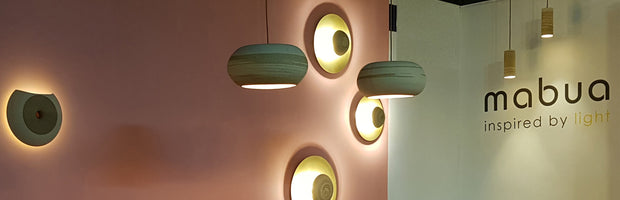
- Ceramic on the wall: when the bulb is hidden, light spreads across the wall in a soft halo. Pytria delivers exactly that ambient layer.
- Wood: the wood veneer of Drop filters the light and gives it a honeyed tone. The fixture becomes a glowing object in its own right.
- Metal: aluminum, as in Infinity, allows slim lines and well-directed light. Suited to dining tables and desks.
Think about the finish as well: a white glaze inside the dome reflects more light, while a dark finish makes the light a little softer.
In short
To light a room well, follow five steps:
- Check how many lux the room needs in the chart.
- Multiply by the floor area to get total lumens.
- Split the light into three layers: general, task and ambient.
- Pick one color temperature for the whole space, usually 2700K–3000K at home.
- Hang at the right height, and choose a material that sends the light where you need it.
Every Studio Mabua fixture is handmade in Moshav Olesh, Israel, in the finish of your choice. Not sure what suits your space? Send us your room's dimensions and a photo, and we'll help you choose. Or start with our pendant lights and wall & ceiling lights.